




Contact
Verbundkoordination
Dr. iur. Timo Faltus
phone: + 49 (0) 345 / 55 23 168
fax: + 49 (0) 345 / 55 27 293
timo.faltus [@]...
Martin-Luther-Universität Halle Wittenberg
06103 Halle (S.)

BMFTR-Project MEDphage
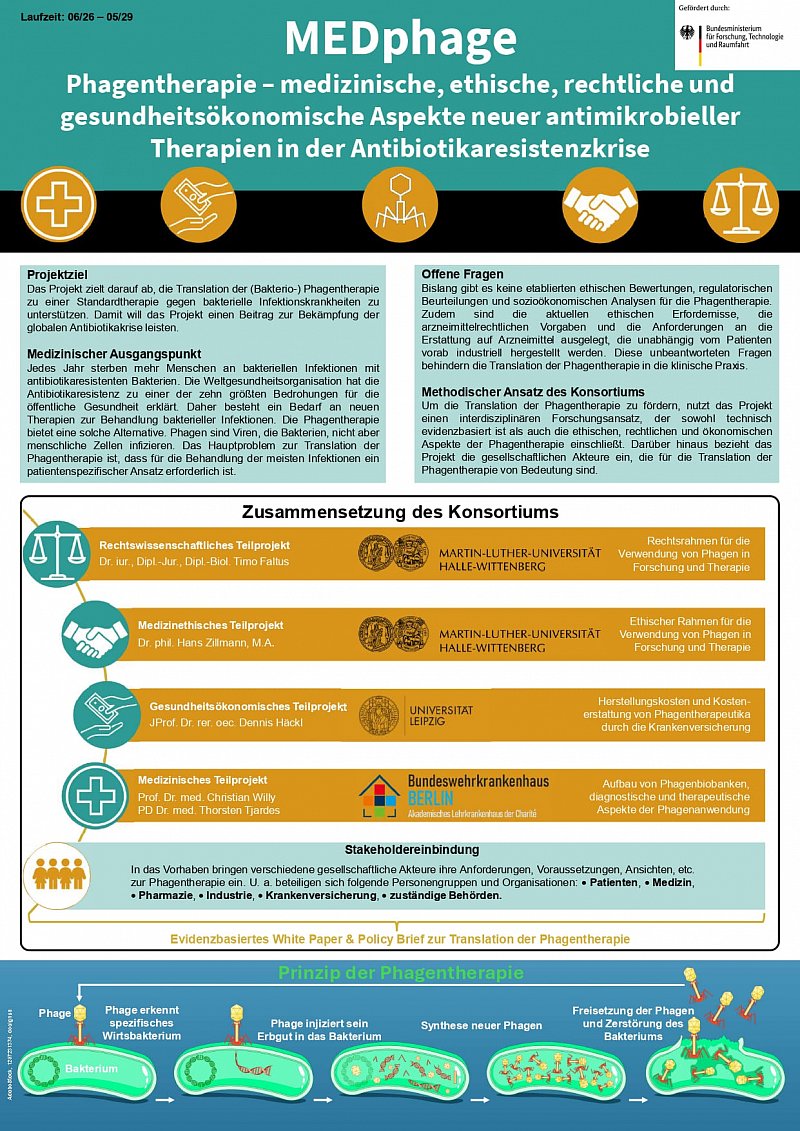
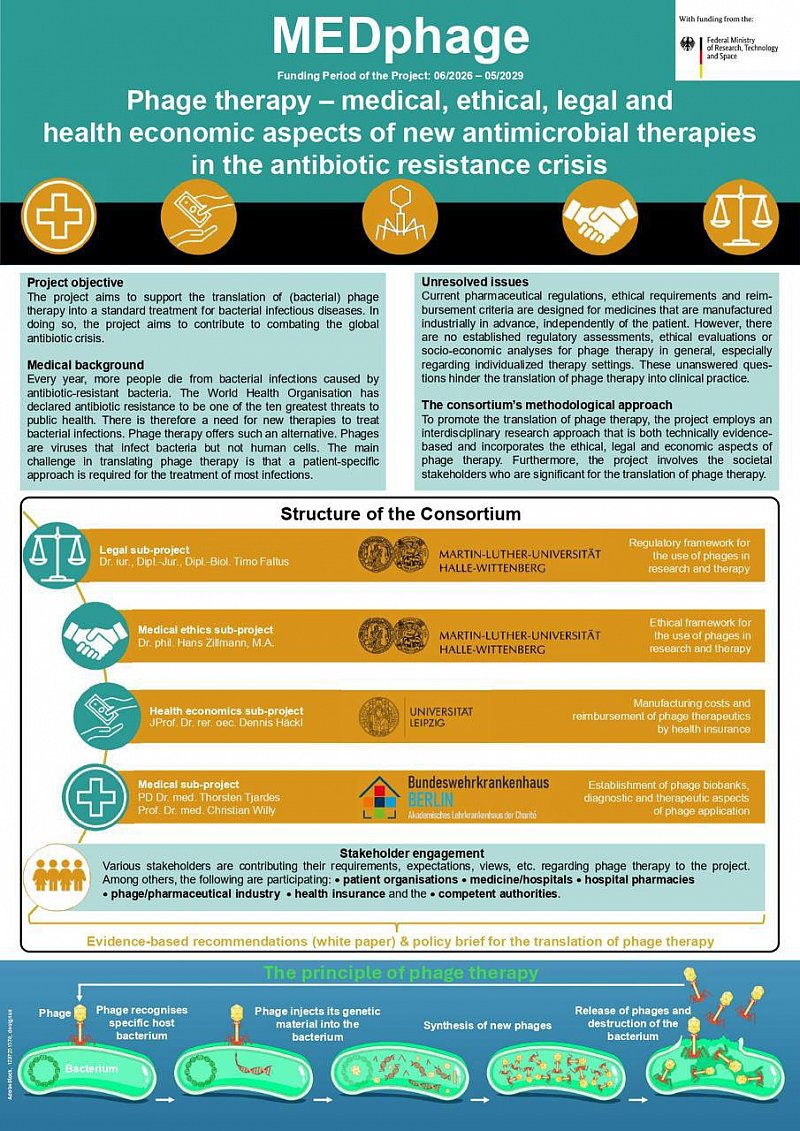
Phage therapy – medical, ethical, legal and health economic aspects of new antimicrobial therapies in the antibiotic resistance crisis
Project Duration: 01.06.2026 – 31.05.2029

Figure: Adobe Stock / 643597600 / Dabarti
Aims and interdisciplinary approach of the project
The “MEDphage” collaborative project, funded by the German Federal Ministry of Research, Technology and Space (BMFTR), aims to support the translation of (bacterio-) phage therapy into a standard treatment for bacterial infectious diseases. In doing so, the research project also aims to contribute to combating the global antibiotics crisis. To this end, ‘MEDphage’ is developing an evidence-based translational model for phage therapy, taking relevant stakeholders into account, whilst consistently identifying, addressing and resolving ethical, legal and socio-economic aspects.
The MEDphage project employs an interdisciplinary research approach which is, on the one hand, technically evidence-based (> medical sub-project) and, on the other hand, also encompasses the ethical (> ethics sub-project), legal (> legal sub-project) and health economic aspects (> health economic sub-project) of phage therapy. Furthermore, the project involves the societal stakeholders who are relevant to the translation of phage therapy.
(Bacterio-) phages for the treatment of bacterial infections
Every year, more people die from bacterial infections caused by antibiotic-resistant bacteria. The World Health Organization (WHO) has declared antibiotic resistance (antimicrobial resistance – AMR) to be one of the ten greatest threats to public health. There is therefore a need for new therapies to treat bacterial infections. Phage therapy offers such an alternative.
Phages are viruses that infect bacteria but not human cells. Phages infect and lyse their host bacteria. This kills the bacteria. In medical applications, this mechanism of action is intended to treat the cause of the bacterial infection. Phages can therefore be effective where antibiotics are increasingly failing – without harming human cells and, unlike conventional antibiotics, without harming the healthy microbiome.

Figure: Adobe Stock / 2037121645 / KI
Figure caption: Schematic illustration of the replication cycle, in which a bacteriophage injects its genetic material into the bacterium and uses it to replicate the phage. Once the new phages have been assembled within the bacterium, the host cell is dissolved (lysed) and dies, thereby releasing the mature phages to infect further bacteria.
Technical, ethical, legal and social challenges of phage therapy
The WHO, the European Union (EU) – including the European Medicines Agency (EMA) – national parliaments and several medical societies regard phage therapy as a promising approach to the treatment of bacterial infections and as a strategy for tackling the global AMR crisis. These institutions also call for the unresolved ethical, legal and health economic issues surrounding phage therapy to be addressed, to facilitate the translation of phage therapy from basic research into routine clinical practice.
The core problem with phage therapy – from a technical, medical, ethical, legal and social perspective – is that phage therapeutics that are not patient-specific can only be manufactured in advance and on an industrial scale, with a static (= always the same) composition, for specific bacterial infections. However, for most bacterial infections, a patient-specific approach is required due to the host specificity of the phages and the diversity of the pathogenic bacteria causing the infection. In such cases, the required phage therapeutics are only prepared after diagnosis for individual patients on request – usually in a hospital pharmacy – and handed over to the physician for administration. In these individualised settings, under European and German pharmaceutical law, no regulatory authorisation for placing the (phage medicinal) product on the market – and therefore no clinical trials – is required by law prior to regular, repeated use.
Furthermore, today’s ethical standards, the requirements under pharmaceutical legislation governing the manufacture and routine use of medicines – that is, not just for individual therapeutic attempts – and the requirements for reimbursement by the healthcare system are designed for medicines that have been manufactured industrially in advance, independently of the patient, tested in clinical trials and successfully assessed through a regulatory approval process. These requirements for phage therapeutics manufactured independently of individual patients cannot be applied to patient-specific phage therapeutics, partly because the technical requirements are different and partly because this, in turn, raises other ethical, legal and economic issues. Consequently, there are unresolved issues, particularly regarding the clinical translation of patient-specific phage therapeutics, which have so far hindered the translation of phage therapy.
Individualised phage therapies are therefore currently only possible and permissible to a limited extent; however, this does not correspond to the scale that would already be required today for the treatment of bacterial infections using phages. Given the growing significance of antibiotic resistance, this need is also expected to increase further.
.
Funding code: BMFTR 01GP2504A-C
Please note that the MEDphage project is exclusively a research project. The MEDphage project is dedicated to research aimed at translating phage therapy from the research stage into clinical application.
We do not carry out clinical treatments, provide individual medical advice, or offer treatment recommendations or therapeutic agents to patients. We do not run our own clinical treatment programmes, nor do we provide such programmes.
For medical assessments, diagnoses or treatment decisions, please consult your doctor or a registered medical establishment.